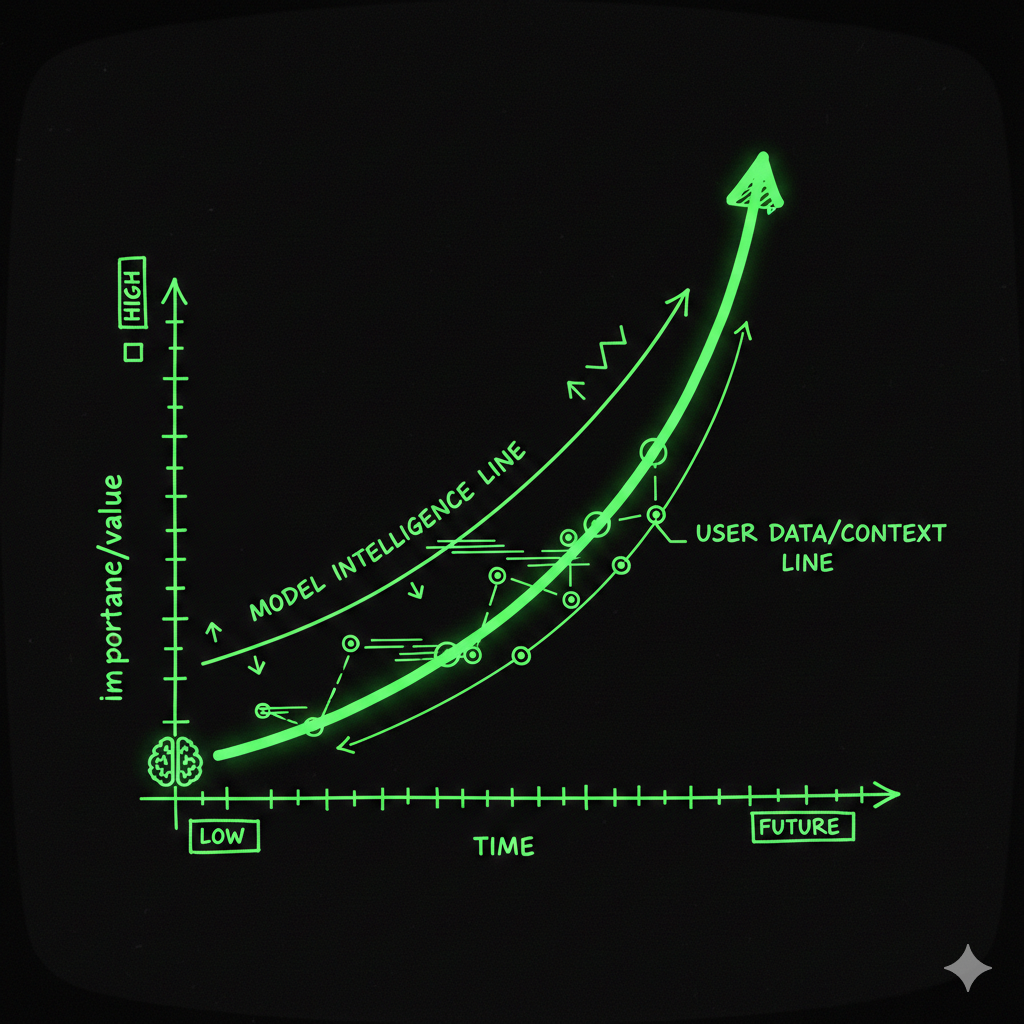
Around twelve months ago I wrote a short piece about the idea of a contextual user substrate: the notion that, beyond a certain point, understanding the user may become more important than continued increases in raw model intelligence.
Since then, there have been a few signs that this emphasis on context and personalization is becoming more explicit.
Memory, 'continual learning' and ChatGPT's code red
There's no major revelation here: consumer software has always moved toward personalization, and AI products are no exception. Improvements in model intelligence clearly make personalization more effective.
That said, since writing the initial piece, all the major labs have focused heavily on implementing and integrating 'memory' while citing 'continual learning' as a major bottleneck.
Just yesterday, Sam Altman announced "code red".
Public reporting indicates the company paused or delayed a number of initiatives in order to focus on improving ChatGPT itself, with emphasis on speed, reliability, and personalization. Personalization was explicitly named as a priority.
I don't actually know how the labs are approaching this. Nobody really knows exactly what they're doing to make personalization better, whether it's more about capturing user data and using it in interesting ways, or more about increasing model intelligence. But I'd guess that capturing user data and using it in interesting ways will become more important than raw model intelligence. Obviously both will be working together.
Building a model-free contextual substrate
Over the past twelve months, since writing this, I've been building a local personal knowledge base for myself. I think having your own contextual user substrate, free from any particular model, is critically important. The last thing we want is for everybody to get locked into a particular model or provider.
I built this for myself, and it's now launched as both a product and service, and it's also open source. The core idea is a strong belief that users should be able to manage and own their own contextual user substrate, separate from any individual model provider.
Try it out at ra-h.app.
Related: This builds on the original contextual user substrate piece and connects to why your context is so important.